Decisions, Decisions

Decisions, Decisions

‘When we find the fish, or when the fish finds us, I want to
go down in the cage and take some pictures. No one’s ever
been able to photograph a fish this big before.’
‘Not a chance,’ said Quint. ‘Not on my boat.’
‘Why not?’
‘It’s foolishness, that’s why. A sensible man knows his
limits. That’s beyond your limits.’
‘How do you know?’
‘It’s beyond any man’s limits. A fish that big could eat that cage for breakfast.’
‘But would he?’ I don’t think so. I think he might bump it, might even mouth it, but I don’t think he would seriously try to eat it.’
Jaws, Peter Benchley, 1974

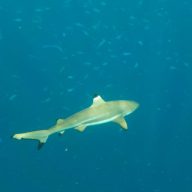
Benchley’s character Hooper, the ichthyologist from Jaws opens up an interesting dialogue here – would the shark choose to eat the cage, or would it not? Benchley is acknowledging the animal of being cable of doing something but perhaps not willing to do it, or rather deciding not to do something it could if it wanted to.

The idea of animals being able to decide for themselves is often thought of in a human contest such as lab experiments, skinner boxes and other artificial constructs for human observation. For obvious reasons, observing shark decision-making in a natural setting is almost impossible. Dr. Eugenie Clark set up experiments on captive sharks in pools to train them to ring a bell to receive food and thus proved that sharks can learn. That was in 1958 and little has been done since in terms of agency.

So, then, what do we know about shark agency, ability and decision-making? Very little. Of course, the great deal of research that has been done has been on food preference, preferred feeding times, various attractants – i.e. sound, smell, sight of possible food sources…there has been a lot of great work in this area but in the area of sharks being free to make decisions to bite us or not – bathers, recreational and professional divers, surfers, abalone divers and various other sea visitors are giving sharks those opportunities on a regular basis and the data seems pretty conclusive that sharks are deciding not to make us a prey item. So why then is this data not being held up as evidence to stop netting and drum lines?

In a profound way, sharks ability to make decisions about their agency have been taken away from them by shark nets, drum lines and other government legislated ‘mitigation’ programs. What would happen if we took those apparatus away? Do we really think that sharks will be lining up to dine on us and that our beaches will turn into a shark feeding zone? We, here in Australia, will never know until we allow them that freedom.
For the multitudes of un-netted beaches around the world, the evidence is pretty clear that sharks are not systematically preying on bathers so why is Australia so loathe to have the same faith as other governments?

There are many ways to explore this question yet the path I keep returning to is the perception that the lawmakers seem to hate sharks. Unlike other countries such as South Africa, the United States and Bahamas who seem to embrace the idea and the reality of sharing spaces with sharks, Australian policy makers seem to have a fear that has bred hatred of these fish.
My best guess as to why this is so comes from that colonial fear of the land and sea of this island nation. The colonists’ description of this country was saturated in fear. To them, the place was barren, haunted, ’in rags’. They felt so alienated by their landscape and its flora and fauna that they developed a deep-seeded mistrust and phobia of their ability to exist in it and so, they have waged war on that space – the most un-colonisable of all – the sea.

Sharks inhabit a world we will (hopefully) never fully inhabit or colonise and as such have become a target of scorn, mistrust and hatred. People can see a lion or tiger or bear (oh my!) coming at them and have developed weapons to defend themselves against any possible encounter. Bathers cannot anticipate a similar encounter with a shark as easily, nor can they adequately defend themselves from it in the same way they could with a land animal. The sea is not the domain of humans and there seems to be a resentment of that fact by human lawmakers.

When did we, the public, ask for shark nets and drum lines? I don’t recall any of us marching in the streets asking for government protection from sharks. So why are we being given it? And more importantly, why are we taking it?

Probability Neglect and WA’s Shark Slaughter

The term probability neglect is a term used in psychology to describe the phenomena of extreme measures taken to avoid the small risk of danger.

The following excerpt is taken from Cass R. Sustein, Probability Neglect: Emotions, Worst Cases, and Law (2001):

Abstract:

When strong emotions are triggered by a risk, people show a remarkable tendency to neglect a small probability that the risk will actually come to fruition. Experimental evidence, involving electric shocks and arsenic, supports this claim, as does real-world evidence, involving responses to abandoned hazardous waste dumps, the pesticide Alar, and anthrax. The resulting “probability neglect” has many implications for law and policy. It suggests the need for institutional constraints on policies based on ungrounded fears; it also shows how government might effectively draw attention to risks that warrant special concern. Probability neglect helps to explain the enactment of certain legislation, in which government, no less than ordinary people, suffers from that form of neglect. When people are neglecting the fact that the probability of harm is small, government should generally attempt to inform people, rather than cater to their excessive fear. But when information will not help, government should respond, at least if analysis suggest that the benefits outweigh the costs. The reason is that fear, even if it is excessive, is itself a significant problem, and can create additional significant problems.

This is a clear indictment of what not to do in the face of a small chance of danger but it is precisely what the Western Australian Government is doing.

The public are not only acknowledging this probability neglect but are pushing against it. Despite this, the Western Australian government is refusing to acknowledge the very small chance of injury to bathers from sharks and has legislated a shark slaughter in defence of human recreational users of the ocean.

Not only does this legislation diminish the value of sharks, it diminishes the agency of the public to decide for themselves whether or not they choose to enter the ocean and take responsibility for themselves.

The human / shark interface is being forced into narrow parameters within an artificial construct of man-made legislation with the aim of having the human side of the interface the ‘winner’. It would seem that when the rights of animals, including endangered species, are not being protected and the rights of humans to enact their free will are not being allowed that neither side could possibly ‘win’ this game which is being played out without the consent of either party.

Lesley Rochat’s brilliant campaign, “rethink the shark” captures the idea of probability neglect perfectly. It shows, in stark reality, the actual causes of human death per year versus those caused by sharks: toasters and chairs cause many more deaths than sharks.

http://www.lesleyrochat.com/conservationist/campaigner/rethink-the-shark

Various unfortunate accidents can befall human beings anywhere and at any time as Lesley Rochat ‘s wonderful series shows. However, sharks do not even deserve a mention. In fact, human deaths at the hands of other humans rank much, much higher and here, in Australia, where one woman is killed per week by a current or ex-partner, no legislation is being enacted. We need to question the priorities of governments and it appears that the priority of the Western Australian Shark Mitigation Program is not to protect people, it is to eradicate sharks despite widespread international condemnation.
Looking at the policy as being sound on the basis of protecting bathers lives would be erroneous as more bathers die of drowning; 290 to 2 according to the placard below. This hasn’t caused the government to have volunteer surf lifesavers at every beach.
On this basis alone, the policy is dubious and faulty and its real intent is showing. It is a policy to eradicate sharks from the oceans.

http://www.abc.net.au/news/2014-01-06/wa-government-standing-by-shark-cull-after-protest/5185802

This placard is a good example of the probability neglect of Colin Barnett’s shark slaughter policy. The woman holding the sign and much of the public at this rally are much more savvy than the government they have elected. They realise the chance of danger is small, so why then doesn’t the government?

There are various hypotheses here, the chief being a fiscal concern. There is fear of litigation that the government will be sued for failing to adequately protect its citizens while in the ocean. There is the fear of a drop in tourism due to fear of being bitten by a shark…the whole think reeks of the plot of Jaws quite frankly, but in reverse. Colin Barnett thinks he is Chief Brody, Quint and Mayor Larry Vaughn all in one. If the government were to put their policies where their mouths are, they would have volunteer lifesavers at every beach.

The chance of being bitten by a shark is so small it doesn’t even merit discussion. This is the heart of probability neglect; the government is neglecting to acknowledge that the probability of a shark bite incident is small and are instead acting as if it were inevitable. If the government could acknowledge that they are neglecting this probability, then the sharks and us would all be better off.

The Human Language of Sharks

It seems that in the age of the anthropocene that many discussions are happening in regards to humans, animals and the places where we meet. However, many of these discussions concern only one species of our multispecies world – often we humans – and the conversations usually have a colonial attitude in terms of our ability and our right to inhabit the spaces where wild animals live and to be able to do so without impunity and with the presumption of our complete safety. This attitude has extended as far as habitats where human beings cannot live, namely the oceans, and yet still we expect to be able to enter oceans in complete safety as if it is our right as human beings not to dare to be harmed by anything as lowly as an animal.
Our human-created world of technology and resulting
detachment from the natural world we are a part of is causing us to experience and exhibit a form of narcissism that humanity has never manifested to this degree before. We no longer seem to have a fear of the natural world nor awareness that it can better us in any way. Nature seems to have been put permanently on a leash for our psychological comfort and through this concept human law makers and legislators seem completely flabbergasted when nature does get the better of us in some way.
Colin Barnett’s Western Australian Shark Mitigation Program seems a perfect example of this neurosis. The very small chance of a shark having the ability to injure or kill bathers in its own habitat has incensed the government so much that it has enacted what can only be called a genocide on the creatures who live there to ensure the safety of the creatures who visit there. When looked at in a rational, non-hysterical way, this can only be seen as some sort of colonial madness. Sharks are not creeping out of the water and sneaking into people’s homes at night to feed on them, they are not hiding under our beds, they are not organising sleeper cells in our cities waiting to take over. They are creatures who have been here for much, much longer than us and much, much longer than any other creatures on Earth. They are living their lives in the oceans of the world and should be allowed to do so unmolested.
Why is this hysteria occurring despite widespread opposition and condemnation from Australia and the world? Why are sound minds and logic being ignored in favour of a small minority of paranoid lawmakers?

I believe much of this has to do with language. Even as I write this, spell check is continually putting a squiggly green line under the pronoun ‘who’ whenever it follows the noun ‘shark’ or ‘animal’ or ‘creature’. Our language has been hard-wired to think of animals as ‘it’ not ‘he’, ‘she’ and definitely not as animals who think, feel, remember, choose, decide or act. Their ability and agency has been diminished by our language and thus by our laws. Our colonisation of their spaces and their lives has not just come from our nets and boats and hooks and guns but from our language, which has colonised their ability to be.

July 8, 2014