Solomons’ Table

At Solomons Table – At it, On it, Under it

Provisioning for Animals

Provisioning is a disruptive practice in that people in positions of power (i.e.: having food to spare) are doing it for an outcome that is usually capitally driven. This is why provisioning matters and also why provisioning is such an interesting area. Provisioning for animals who are provisionally wild is interesting; it always has been.

The starting point of any discussion on provisioning should always be the endgame. Are the outcomes benign or malicious? Can they even be either of these or both? What are the ethical aspects? What are the ecological or animal health dimensions? What cascading effects can provisioning to wild animals cause?

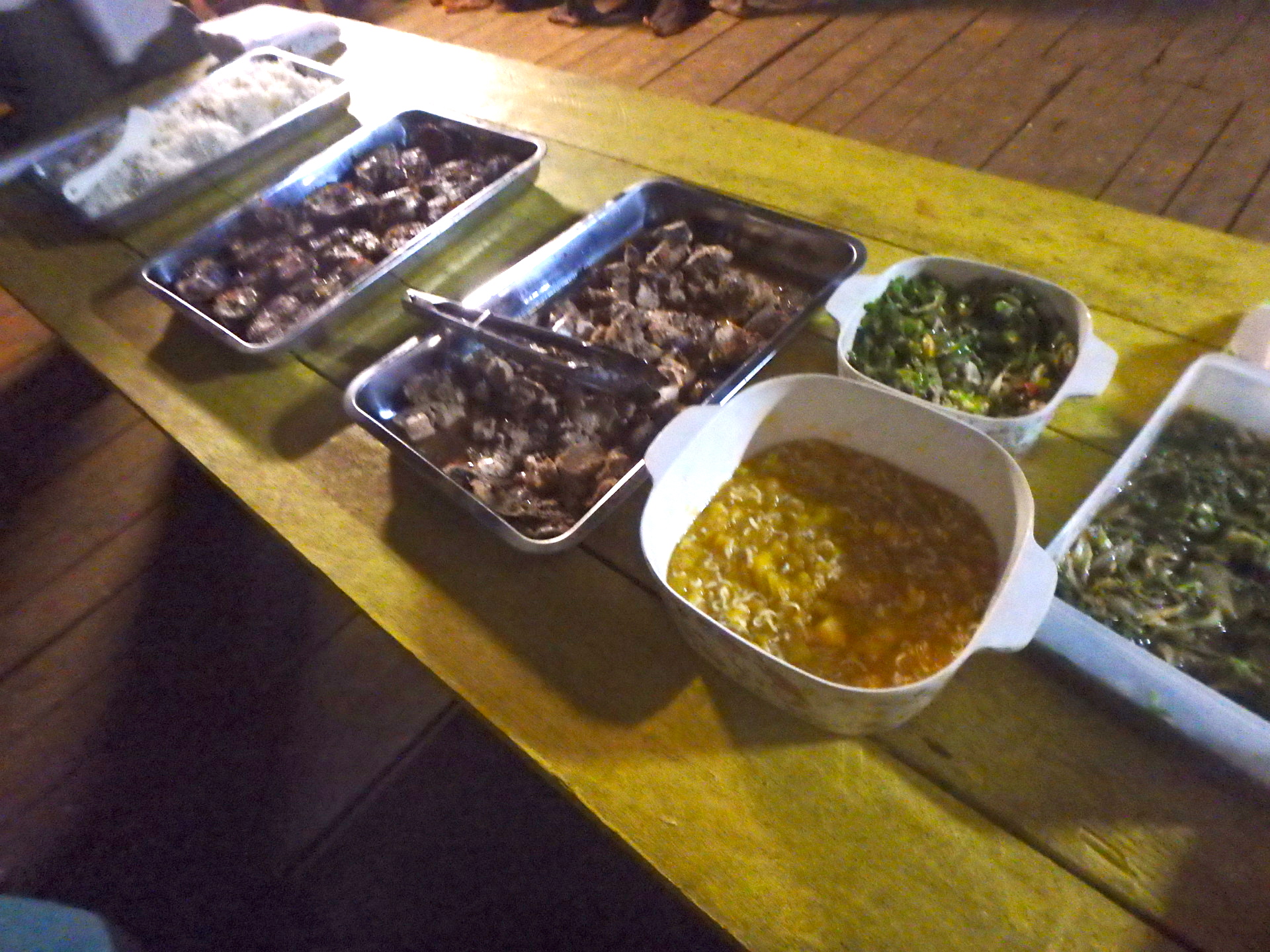
While Donna Haraway is astute in observing that we become together with our biospheric others, I am continuously made aware in how we come apart with them as well. After four trips to the Solomon Islands, this apartness is becoming more apparent. The table has, and most probably always has been, a Maginot Line as I try to navigate the niceties of Solomon hospitality while emaciated animals cower at my feet hoping for a morsel of food and a crumb of kindness. This dilemma has plagued me on each visit. My fellow volunteers give me ‘the look’ which is easily deciphered by me as ‘don’t you dare give any of that food which these nice people, who have very little, have so kindly prepared and shared with us, to the dog, cat chicken or whatever other half-starved creature lurking under the table is begging for it.

While my human companions have one look for me, my biospheric others have another. It is a look I find much more compelling and much easier to oblige. This look is one of intense hope and longing mixed with grief and suffering. This look is ‘please’. Please comes in a huge range here. I have received it with the same intensity of my own cat at home – a gentle plead which if I refuse, will result in him going off to find something else to interest him. I have received it with much more intensity accompanied by mewls, whines, leg rubs and toe rubs. I have experienced it where exposed ribs washboard against my shins and worst of all I have received it with such nihilistic resignation that the heavily creased eyes of the street dog in questions in Gizo after giving me the look it had clearly given so often for so long it merely lowered its head back onto its bony paws and fixed its eyes on nothing. I doubt very much it lived through the night.

This minefield of etiquette and separation is always troubling and so, to return to Haraway, I am staying with the trouble as avoiding the trouble has become very tiresome.

I am a volunteer teacher in the Solomons at a remote jungle school every year. I also research sharks and the people who share this place with them. My dual role is mirrored in the dilemma of feeding or not feeding ‘the please’. I am trying to understand what provisioning sharks can mean and how it can matter yet I am also trying to understand why responding to the please of the terrestrial biospheric others is seen as such a no-no. While all of this ‘to feed or not to feed’ noise is humming away, the mosquitoes are endlessly feeding off us. We are all food for each other whether we like it or not.

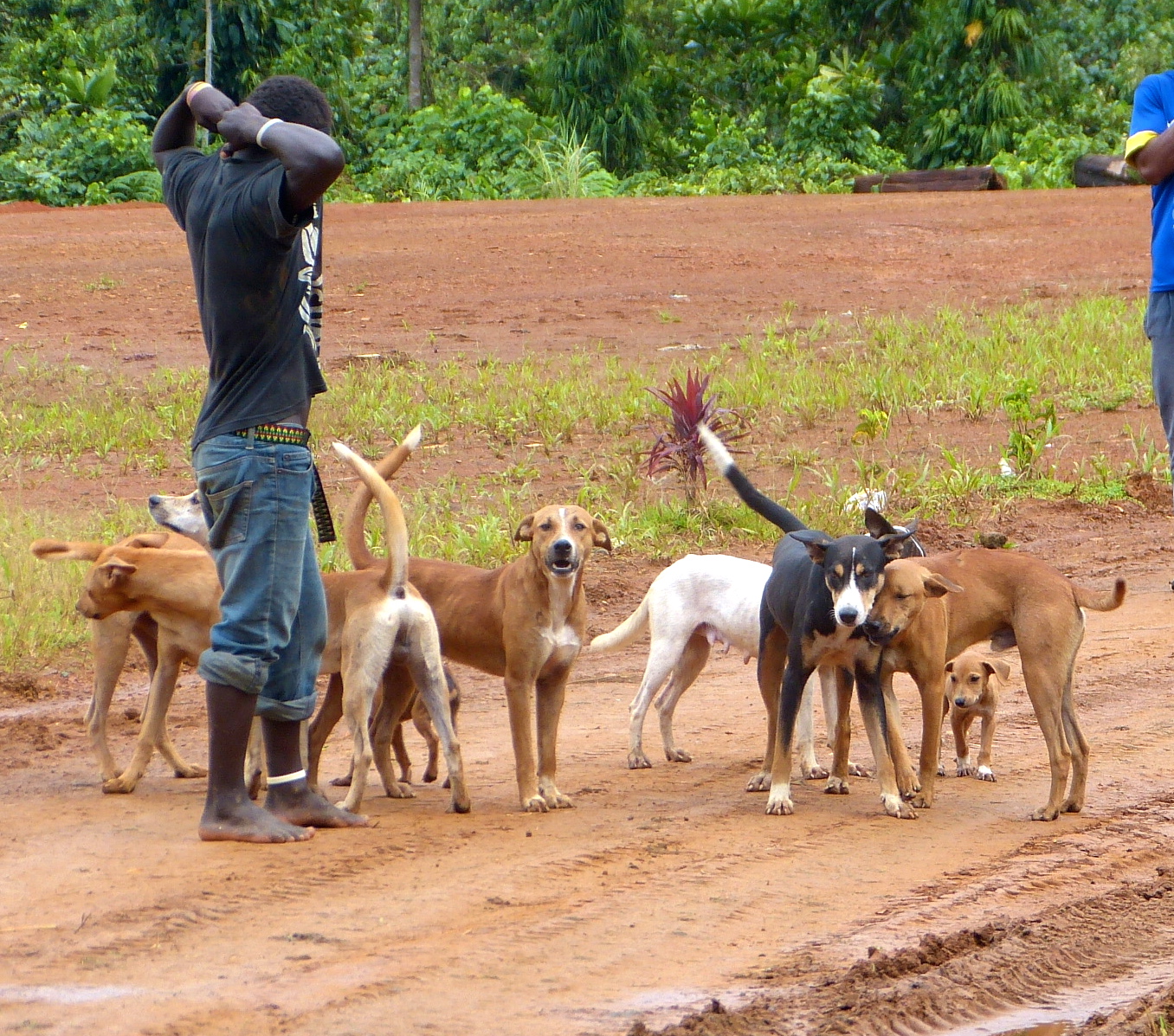
I understand that throwing the scraps of recently filleted fish off the jetty to waiting fish and soon-to-be-there sharks is just good common sense. ‘Give back some of what you have taken’ is a nice new way of looking at it but in reality it makes sense to put the ocean waste back in the ocean so you don’t stink up your home area with rotting fish guts. It is simple practicality, no more or less. There is no ‘please’ to respond to because a ‘please’ has not been issued. However, giving what to us is barely a bite or two of food to an animal who is in physical distress from malnutrition does not seem such a terrible infraction. I have never once been told by any of the many Solomon Islanders I have broken bread with, not to feed the animals. I have refrained because my Australian friends are fearful I will be committing an insult upon them by doing so. I have sneakily given a piece of my own bought biscuits here and there in an answer to a ‘please’ when there has been no one there to admonish me. On this most recent visit, the school has ballooned to a healthy 76 students and as such has acquired extra kitchen staff and another teacher as well as many camp dogs – seven in total including one bitch with two pups and two small kittens. Animals are always a welcome sight for me and this was no exception. These dogs were true camp dogs; they served as sentries to the school and were invaluable pig hunters, providing the school its only source of protein besides expensive tinned tuna which has to be purchased in Seghe then transported 40mins by boat and 10kms by truck up a logging road to the school.

These dogs bore the many boar scars and were hardened by their life of near starvation and constant kicks. Despite this, they often slept on the porch in the classroom doorway close to us but not too close. Not long after we arrived the dogs all retreated to the periphery of the jungle and their yelps and fights could be heard. It reminded me of a famous line:

from the homicidal bitchin’

that goes down in every kitchen

to determine who will serve and who will eat.

“Democracy”, Leonard Cohen, 1992

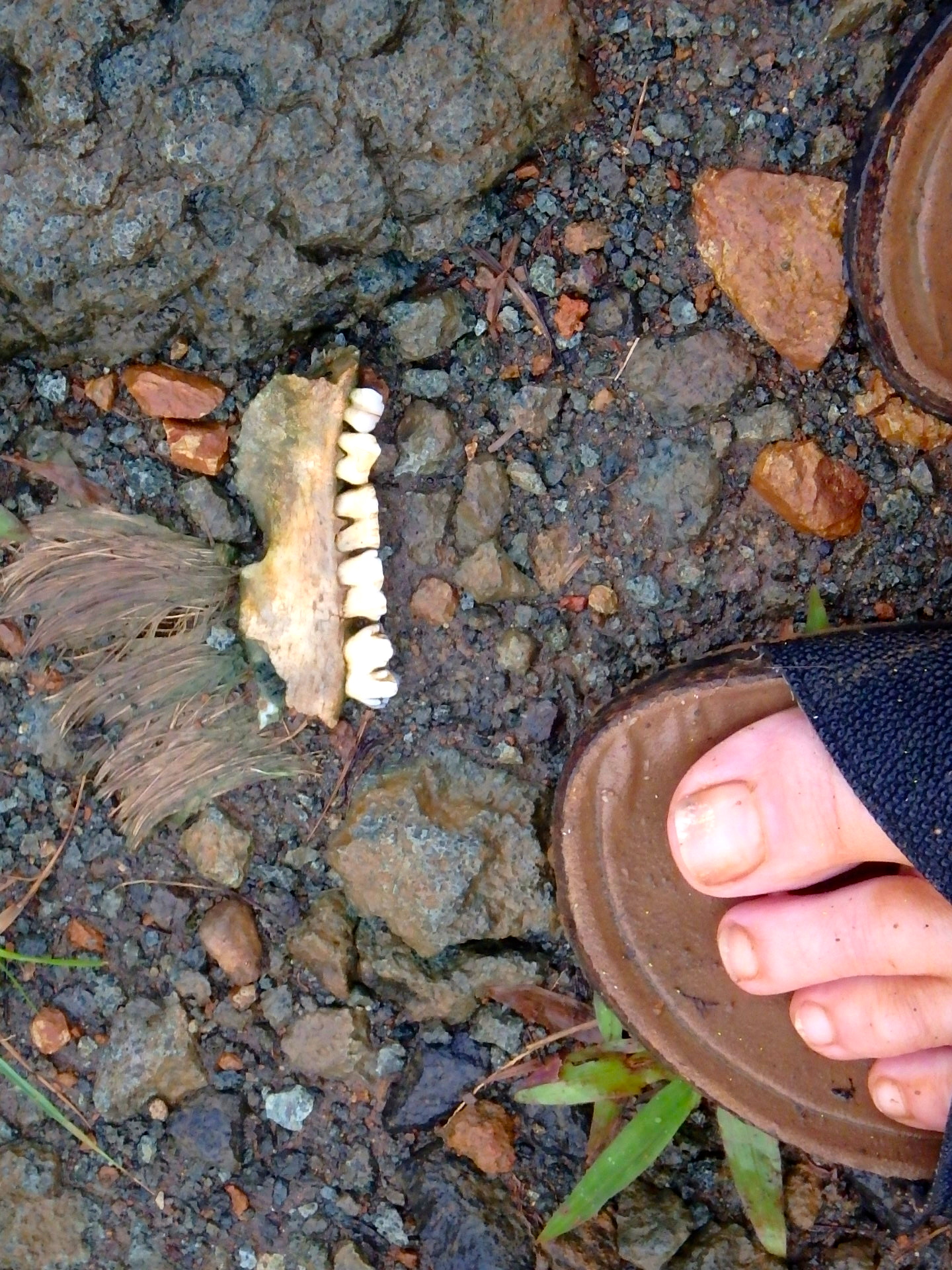
These frequent yelps and cries are often from humans just as much from fellow dogs. Everyone is fighting over scraps here. That first afternoon, two boys with bush knives and a pig hoisted between them returned to the school with three victorious and proud dogs. I did notice a lessening of rib indentations on the dogs almost right away and we all enjoyed our welcome feast and were grateful to the pig whose life had ended violently for all of us. The next morning as I walked through the endless mud to the classroom I spotted what at first seemed to be a set of false teeth. On closer examination it was a broken section of the pig’s lower mandible. I stepped over it every day for the next 10 days – a daily reminder of who got to eat and who was served.

While my annual meeting with the sharks of Marovo Lagoon was postponed for two days as we sat in Honiara during torrential rains, when we finally arrived it was worth the wait. I only had four hours of snorkel time instead of two days so I donned my snorkel as we arrived and despite the ongoing heavy showers, still managed to interact with sharks. After more than two hours, I had a full camera of wonderful underwater footage including an eagle ray and the resident Black tip reef sharks. This place is famous for them as the owners used to regularly feed them from the jetty. They were here in large numbers and were spotted right at the surface as you disembarked from the boat. After a foolish Australian tourist ignored the very clear warning sign on the jetty not to dive or jump off the jetty, he was promptly bitten on the head by one of the small usually docile resident or ‘home’ sharks. Splashing on the surface is a sign of feed being thrown in for them – hence the warning sign on the jetty.

Five years ago there were up to 14 home sharks patrolling the channel near the jetty. On this trip I could only count three different sharks. The owners stopped feeding the sharks after the tourist’s wilful disregard of the sign which brought negative attention, as most shark bites do. All accounts I have read of the occurrence in the Australian media have failed to relay this vital piece of information in the story.

The sharks in this place are special. They are habituated to people and their comportment and proximity indicate it. The only footage I have taken of sharks where their proximity fills up the frame of my camera has been there. They are not shy or fearful or curious unlike most sharks I have encountered. We are part of the landscape for them as the waters are often filled with tourists. In fact many of these sharks have never experienced the channel without people – they have been born and raised with the snorkelers and divers here. The foot long pups are often seen patrolling the shallows of the sandy sea grass lagoon while the adults are in the deeper part of the lagoon or the channel. These sharks will easily swim within 2 feet of people and rarely change direction if they see a diver approaching. This is in direct contrast to the other White tip and Black tip sharks I have encountered in other parts of the Western Provinces. These other sharks will abruptly retreat, change course and quickly vanish out into the blue if they see a diver approaching. Most of my other footage of sharks in other locations requires a bit of squinting and equal parts imagination to decipher that dark blue shadow passing out of frame is a shark.

The Uepi sharks cannot be surprised by us. We are about as surprising to them as the coral they pass by or the schools of fish they swim through. We have always been there for them. Their hospitality is ongoing while ours has been removed through the wilful act of a disrespectful tourist. Most sharks when surprised display a fear ‘shiver’. It is a visible ripple that vibrates through their skin. It seems like their mouths open slightly in surprise as well before they quickly turn and speed away in haste. I witnessed this very thing 2 years ago while snorkelling along a coral drop off. I had been following a puffer fish around a curve when I turned around to swim over a large coral bommie close to the surface. A black tip reef shark was coming up from the drop off when I surprised it by suddenly appearing in its path. It shivered and swam off before I could get it in frame to press record on my camera. Clearly this wasn’t one of the Uepi sharks.

Although these 3 remaining Uepi sharks are no longer being fed, they have still staked the Uepi Island channel as their home. The others are probably not far as reef animals are territorial and can usually be found in the same small areas. They are probably just doing what they would naturally do but on the outer edges of the reef. I am quite sure if the operators chose to resume feeding the sharks from the jetty again – there would be 14 of them patrolling the channel with a day or so. What does all this mean for us and for the sharks? Are they hungry? Are we taking more than we are giving back? What does provisioning for shark matter in a world of diminishing returns? Do we risk turning Uepi into a circus of the sea for paying tourists or are we helping a vulnerable species get a fin up in a lagoon system increasingly choked with logging sediment and depleted of tuna?

The waters of the Solomon Islands should be busting with sharks. There are 922 islands and atolls in an area of 29,785km2. There are drop offs, deep abysses, open ocean channels and shallow lagoons. In short there is every type of system to support sharks. So, where are they all? Two years ago I travelled to Langa Langa lagoon on the island of Malaita to track down one of the infamous shark callers. Not only was there not a single shark caller, there was not a singe shark. The lagoon was stagnant, full of garbage and algae and empty of any abundance of sea life. The corals had been mined to build the famous artificial islands of the lagoon. With no coral to hide in, all the fish had gone and with them, the sharks.

After the misery of Langa Langa I headed back to Honiara to connect with my friends. A week later we went to Gizo. Despite beautiful, healthy reef systems, I failed to see a single shark. My friends who went diving and saw a couple of sharks said the dive masters used a half full bottle of water which they would crunch and roll in their hands on a dive to attract sharks. The sound mimics a struggling fish – similar to the ancient coconut rattle the ancient shark callers in Langa Langa used to use. At Gizo I attempted this lure while snorkelling for over 3 hours around a denuded reef system. Not a single shark turned up.

At the school where I volunteer teach, I showed my students pictures of a White tip reef shark, a Black tip reef shark and a Tiger shark and asked if they had ever seen any of them. They had only seen Black tip reef sharks from a boat or a jetty. They had only seen the other two at the markets ‘after they are dead, before we eat them’. Whether or not this is accurate information is open for debate. All the operators I have asked over the past 4 years have never seen or heard of seeing a Tiger shark in the Solomons.

This brings us to another separation – the people and their surrounding flora and fauna. While for the first three years I believed the lack of information about the indigenous wildlife of the Solomons to be a language chasm or a cultural withhold but I have since come to understand it is a lack of understanding and knowledge on the part of the Solomon Islanders.

Many of the children’s stories have foxes, bears and dragons in them. To be fair, the Solomons have only 4 indigenous land mammals – bats, rats, pigs and cus cus, a native possum that only seem to be on some of the islands. However, it would seem to make more sense to have stories of a neighbouring island’s cus cus than a dragon which lives only in imagination. Even questions about frogs seem to bring up disagreements about what is ‘true’ or not. The students seemed to somewhat agree that there were no green tree frogs of any sort in the Solomons but some disputed the existence of a brown and white ground frog which some insisted existed. If the people have very little understanding of what animals they actually have, how can they manage to keep the few they do? In general, animals – all, seem to be mistrusted and feared by a lot of the people I have met. An idle dog or cat will sometimes receive a tail stomp or a kick by someone passing by just for being within reaching distance.

After a week of teaching at the school and hopeful visits from a small ginger and white kitten and a black and white kitten both visibly emaciated and one in a state of agitated despair, my anger increased as to why I could not offer some of my rice and tuna. When I would bring my nearly empty bowl to the water tank under cover of darkness, I’d scoop out the remaining spoonful and place it on the wood in the mud and watch the kitten greedily ingest it, its ribs on its sides straining against its skin in its enthusiasm. I do understand that feeding wildlife is a complex issue, but this was a domestic kitten that someone had brought way up the 10km mountain-logging road here to this school. Yes, it would continue to mewl and beg for food if we ‘encouraged it’. It was someone’s responsibility – it is all our responsibility. A mere touch from us to this little male kitten would make him erupt into purring which could be heard from 4 feet away. He would regularly sit in on class and sometimes fall asleep on my feet as I stood talking to the students.

The following week my friends acquiesced and when our Solomon brother Douglas brought us up a fresh snapper on the logging truck, my friend saved all of the off cuts for me to give to our little ginger and white mate. He ate his fill, his ribs smoothed out, his purring increased and he spent the whole night playing with our feet and then sleeping peacefully on my friend’s suitcase. We received a great reward just for responding to a small ‘please’.

S.E. Laight 2015
OLYMPUS DIGITAL CAMERA

P1120283Screen Shot 2015-06-27 at 10.55.01 AM

Why I love Sharks

I was recently asked why I love sharks, and I was quite frankly stumped. It got me thinking: why do I love them, what is the love about and when did the love start? “I just do” is not a valid answer and it doesn’t enlighten the inquisitor or myself. There is a genesis for everything and so I am on an historical fact-finding mission to find out. I am hoping that by unravelling this deep relationship, which has inadvertently shaped the course of decision making in my life, I can get to know myself and sharks a little bit better.

As a young child growing up in Canada, I was fascinated with animals and particularly my father’s library of great books. While my brother and cousins sneaked peeks at the sexy books, I would lose myself in Jacques Cousteau’s The Silent World with its full-page colour pictures of sharks. The colour blue and its myriad shades had always fascinated me. When I saw pictures of the ocean, I was drawn to it. In my box of crayons, the turquoise and teal crayons were always worn down to a tiny nub, they were, and remain my favourite. When I would see sharks suspended in those glorious colours with their large eyes staring back at me from the pages of those books, I just wanted to be there with them.

The blue shark, or as I called it as a child, ‘the funny face shark’ was a particular favourite as its large eye transfixed me and it long angular nose looked comical and sweet. I never seemed to associate it with danger.
Children, especially young boys go through definitive stages of attraction as they grow: they start with a fascination for trains, then pirates/dinosaurs, then sharks. I defy anyone to find a 6 – 12 year old boy who is not fascinated with them. They may not ‘love’ them but they are certainly curious and entranced by them and many of them do ‘love’ them and the lucky ones get to continue that love throughout their lifetime.
I am neither a boy, nor 6-12 years of age, but something happened to me all those years ago when I looked at that ‘funny face shark’ and it has stuck with me.
I loved the look of sharks. The various shapes of their streamlined bodies, the white soft looking lip which revealed teeth when open, the eyes which seemed faintly cat-like in some and faintly mammalian in others…they lived where I wanted to – in the myriad shades of blue. I so wanted to be there with them that I would have regular dreams of sharks as a child. I often dreamed I was on a cement jetty at night with stairs leading straight down into a milky blue sea which was lit from below and in the light I could see the shadows of sharks swimming in circles. They were calling me, not with words, but with enticement and we both could feel it. I would enter the water but never really see them, just smudgy black shadows passing before, under and above me in the milky blue. I never felt afraid in these dreams, I just felt longing. A yearning to really see them, a deep wanting to be able to stay and live there the way they did.

My parents acknowledged this love of nature I had and encouraged it with subscriptions to National Geographic and other kid friendly versions of wildlife books and magazines. While I loved all animals, the ocean residents, particularly the sharks, were and remain my favourites.
Looking back, I think it may have something to do with forbidden space and not belonging there. I don’t have gills and can’t live where they do, but I wanted to very much and still do. It is a world that is somewhat forbidden to me and therefore is very appealing. It was also very far from where I lived in Canada. Although as I grew up I realised a short 3-hour flight would have me smack dab in the middle of shark heaven, as a child it seemed like a completely different planet and one that I would never experience.

My dear late father, Robert Francis Laight, was an enthusiastic wildlife lover. We would watch endless hours of wildlife TV and sharks in particular were a bonding event. It was something we loved to do together and my love for him and sharks are very much entangled. And although my love of sharks took me away from him to the other side of the planet, something which I believe hurt and saddened him deeply, I also believe he would be very proud to see me finally pursuing this love on a professional level.

This love, and I do not use the word lightly or with any irreverence, it is a love, has also been fostered out of a love for the misunderstood. I have always had a deep fondness for large ferocious-looking creatures and would display deep distress at smaller creatures maligning or killing it. The song Puff the Magic Dragon still wounds me to the core. The thought of a big, scary, lonely dragon abandoned and alone; that is how I see sharks, an ancient species being left behind. I do not like judging a book by its cover and I have always resented the idea of large teeth or claws being a sign that the creature wants to drag you out of your bed at night and eat you. It has a right to exist just like any other small furry creature and should be afforded the same respect. This awareness was fostered at an early age and stories like the Selfish Giant, Jack and the Beanstalk, The Three Little Bears…all with a large, misunderstood antagonist would see me rooting for the large, misunderstood antagonist. I felt that I was the only one who could see that the Selfish Giant was a good but lonely and misunderstood man, that the Giant was right to be angry at Jack for trespassing on his property and that The Three Little Bears were right for being angry at the little girl for breaking and entering and damaging their property. The children in these stories were all in the wrong and my sense of injustice would get riled up. When I saw people killing sharks on TV, I would feel rage at people taking living beings out of a world that didn’t belong to them. They were trespassing and killing. I felt a sense of moral outrage – they were slaying my giants.

The many lakes and rivers near my home were my summer playground. They were where I learnt to swim, cliff jump, climb under waterfalls and fall in love with water. They were also where I encountered fishing first hand. My family are all avid fishers and I grew up watching trout being pulled from many waterways. Fish has never been a food I have enjoyed and I believe it comes from first hand experience of seeing them caught and killed. I am sure if I had witnessed every piece of meat I have ever eaten killed before me I would feel the same about meat, but my meat killing has been sanitised and kept from view.
Watching fish squirm and wriggle in pain on the end of hook and then gutted while still alive was not a pleasant sight to see. The blood and the silence were very disconcerting for me. Seeing a living thing endure a painful death in complete silence was unnerving. I wished it could scream so people would be shocked and stop hurting it. But it didn’t it just thrashed about on the rocks making a slippery thudding sound and its blank eye, so different from when it is seen underwater full of life, would stare ahead, seeing nothing but its own demise as its mouth gaped and open and closed and its gills ran red with blood.

My father then began keeping the fish alive in a bucket of water or in the kitchen sink to avoid my distress at seeing him kill the fish. He eventually succumbed to my pleads and would often release the fish back into the river. In hindsight, I think it was a relief for both of us. Although my parents enjoyed fishing to very late in life with day fishing trips in Florida and the Bahamas, I do believe they lost the taste for it too. A silent death is still a death and does not diminish the suffering of the fish just because we can’t hear its death rattle.

As we have seen recently, the death of sharks is widespread and barbaric. Sharks are having their fins removed from their bodies while they are still alive and then thrown overboard to bleed to death and drown. All of this is completed in horrific silence with just the sound and sight of the shark’s nictitating eyelid flickering up and down in pain and suffering. Silence does not negate or obviate pain; it just cushions us from its reality.

Is this being allowed to happen because we don’t hear it? What other factors are at work here to allow for such barbaric suffering of our oldest Earth companions?
The fear and mistrust of an animal that is capable of killing us is high on the chart. We have been so effectively cordoned off from our natural home that we have become desensitised to the very small prospect of an animal killings us. This is an inherent problem in the entanglement of humans and animals. Encased in our boxes where we glance out of glass safe in our beds, we have forgotten that humans have existed outside with animals for millennia, and we are still here, miraculously, they haven’t managed to kill all 8 billion of us off yet.

This, I believe, is what was at the heart of the Western Australia shark cull, or Shark Threat Mitigation Program as it is called. Ocean users are aware that there are sharks in the water and that the chance of encountering one is minute, yet we still choose to use the oceans for our recreation. It is a chance we are willing to take. Sharks on the other hand, have no other option. There is no chance for them to take, it is their only home and yet their very existence is a game of chance against alien invaders. They are being wiped out to ensure a safer place for occasional recreational visitors. Seen in this context, the idea is completely preposterous. Of course, there are other factors at work such as the globalised shark fishing industry, the reliance on sharks as commodity and status symbol and probability neglect but, overall, the needs of the individual human recreational users of the oceans (less than 20 of whom are killed per year by sharks) are being placed above the needs of over 100,000,000 sharks per year who are being killed in our name. This is happening because human beings seem to be enraged by the thought of an animal having the ability to kill us. It is as if our new-found technological capabilities have rendered it impossible for us to fathom that a mere animal could get the better of us. What they really should be flabbergasted by is that humans have managed to wipe out a species that pre-dates us by 350,000,000 million years and doesn’t even share the same habitat with us.
Governments and policy makers seem able to sleep better at night if any threat of unmanageable wildlife is suitably managed and any thought of litigation is swiftly put to bed. This begs the question, does the ability of an animal to kill us allow for us to kill them in record numbers amounting to nothing less than genocide?

Begin Anew

And so we end 2014 and begin anew. What progress has been made this year and what have we learned? Quite a bit, actually.

The good news:
Pope Francis announced that dogs do in fact go to heaven. This is great news for all of us dog lovers out there who look forward to reunions with our much loved long lost pooches. It’s also a huge reversal on the long held great chain of being hierarchal theory that only humans are special. All of us dog-lovers have always felt this not to be the case and it’s a huge step for the leader of the Catholic Church to concur.
The largest marine park monument came into effect under US President Barack Obama. It’s three times the size of California and it is a no-go zone for fishermen, tourists and other terrestrials. Also under Obama, more land has been set aside for parks and reserves making the protected areas the largest in US history.
According to the Pew Charitable trusts, shark fin consumption was down 90% in Hong Kong in the past two years so hopefully Wildaid and Yao Ming have made a dent in the psyche of islanders, let’s hope they can do the same for the mainland Chinese where data is woefully and disturbingly unavailable.

Here is NSW, the government wisely decided not to dismantle the marine parks, thanks to public response and action. Let’s hope they don’t do a backflip. Also, the message of overfishing is finally getting out to the mainstream, and SBS’s “What’s the Catch?” added to this message. I have two friends who have stopped eating fish because of it and others who are foregoing the 4 staples, prawns, shark, tuna and salmon in favour of more sustainable species. This is great news.

The bad news:
Elephant and Rhino poaching in Africa is still endemic. A supposed 22,000 elephants were killed this year and the largest elephant ever recorded by biologists, Satao was killed in May. Biologists are recording that elephants now know that their tusks are putting them in jeopardy and are trying to hide them. Think about that for a moment. Elephants have witnessed such brutality against their kin and have watched poachers kill them and then cart away their tusks that they understand the connection and are trying to protect themselves by disguising their assets. Our knowledge of animal intelligence has a long way to go. That old joke of an elephant’s memory is no longer very funny when you consider that the remaining populations are all suffering post-traumatic stress disorder.
I am only talking about the mega fauna here, but lest we forget our frogs, toads, birds, bats, newts, voles and the all too many other endangered species around the planet.
There is much to be done and much has been done. Let’s hope next year we can add the end of elephant and rhino poaching to next year’s good news list.

Wishing you all a peaceful 2015.

Spearfishing Shark Bite Incident

On Monday in WA, a 17-year-old boy was unfortunately fatally bitten on the leg by a shark while spearfishing. That same night Channel 7 aired “Jaws”. Coincidence? Perhaps not. The mainstream media, like the government, seem to be lagging behind both the science and the public sentiment. The premise of “Jaws” is that a ‘rogue shark’ stalks the bathers of a coastal town. Many scholars including Dr. Christopher Neff have dismissed this theory. Yet, Collin Barnett and his government are playing the role of Quint and exacting revenge on these sharks they believe are stalking bathers.

The ABC has reported that bathers were in the water while the shark was around long before the bite incident. It seems the bathers were aware and were willing to make the choice to swim anyway. Their actions should speak volumes to the WA government and also to the NSW and Queensland governments about bathers’ willingness to make choices without the protection of lethal government legislation. None of the bathers were injured.

What is disturbing here is that the Guardian has reported that people had seen a large shark in the area days before but had not reported it to the water police. Barnett is saying this is why the shark spotter program is ineffective and won’t be deployed in WA. Could we surmise that people didn’t report it because they knew the government would kill the shark? There is no reason for the public to think any different. Could the public’s loss of faith in their government be the reason it wasn’t reported? If so, it is a indictment on this type of lethal government policy and a sure sign that drum lines should be completely abandoned to restore public confidence in their government.

The unfortunate bite victim had apparently already speared and caught some fish. Spearfishing, it is well known, can be a very provocative act if sharks are nearby. Their highly evolved sensory systems, which include their lateral line and the ampullae of Lorenzini, have had over 400,000,000 years of evolutionary tuning to hone in on the vibrations of struggling fish.

The ABC has also reported that the shark was speared in the mouth during the incident and may be injured and that WA Fisheries are looking for the shark. They have also set up two drum lines in response. Hopefully the public will not settle for this backward step response of yet again hunting a protected species. If WA does in fact catch and kill this injured shark and leaves the drum lines in the water, their intentions will be made clear for all to see.

The Guardian has reported that the Barnett government has spent $26 million on ineffective “shark hazard mitigation measures” yet refuse to use South Africa’s method of spotting sharks and warning bathers to get out of the water which only costs $265,000. Although Barnett say he takes no glee in killing sharks, it begs the question why they continue to do it. Scholars have all dismissed the “rogue shark” theory as being false, so then why does the government continue to hunt and kill sharks that injure bathers? It seems to be revenge.

Let’s hope they move forward, as they had been doing before this incident, and follow the science and the public sentiment by removing the drum lines and allowing bathers and sharks to make their own choices about sharing space at beaches. We don’t need governments to decide for us.

Let Heaven and Nature Sing

Let Heaven and Nature Sing

This line from Joy to the World has always filled me with wonder. As a child I pictured choruses of animals in the forests singing and the thought has always made me smile. It evokes images of Rankin Bass stop motion figures from those much-loved Christmas specials of the 1970s. I still love them and watch them all every Christmas.
Animals figure prominently in children’s stories and Rankin Bass are no exception. From The Little Drummer Boy’s companions Joshua the camel, Samson the donkey and Baba the lamb to Topper the penguin in Santa Claus is Coming to Town, the animals are always central characters in Christmas stories.

But I digress, back to heaven and nature singing. In my current readings, which are all critical of western thought and the separation between humanity and that problematic word, nature, this line, though separating heaven and nature, includes humanity as nature; we, all of us, living beings on the planet Earth. This line also brings to mind Timothy Morton and his assertion that ‘religion cries aloud in a green voice’. There is much to say on notions of peace at this time of year and it is nice to reflect on nature and peace not merely as loaded problematic words, but to reflect with a spirit of respect and gratitude in Val Plumwood’s words of how lucky we are for all the critters we are fortunate to share this planet with. Although I often feel we don’t deserve their company, I am continually grateful for it.

As Rufus, my cat of unlimited agency, lies beside me, I am reminded of how much he adds to my life (and my medical bills through his biting) and how our becoming together is an ongoing and ever-evolving process. I have never once been injured by a shark yet my familiar, my cat, has inflicted numerous injuries on me. I don’t begrudge him his ability to be a cat – a predator with sharp teeth and claws. I don’t begrudge sharks their ability to be who they are either. I wish for all of us the ability to keep evolving into new and better ways to be together and to share space with each other in a spirit that doesn’t diminish any of us.

I wish a very Merry Christmas to everyone of us.

The Life Aquatic with Steve Zizou

This is one of my favourite films of all time. It is by my favourite director, Wes Anderson, it stars my favourite actor, Bill Murray and the protagonist is my favourite animal, a shark. But aside from these surface elements, the heart of the film is beating hard with concepts of revenge and forgiveness – two elements of the human-shark interface that require attention.

At the opening of the film, Steve Zizou, an ageing oceanographer styled along the lines of an American version of Jacques Cousteau, is sitting on stage in the question and answer portion following the screening of his latest film, Adventure No.12 “The Jaguar Shark” (Part 1). The film is a documentary which captures the death of his best friend Estoban by a jaquar shark. A person in the audience asks Steve if it was a deliberate choice never to show the jaguar shark.

Ned asks, “What’s next for Team Zizou?”
Steve replies, “Well, that was only part one. It’s a cliffhanger. Now I’m gonna go hunt down that shark or whatever it is, and hopefully kill it.”
To the compare sharing the stage with him, “I don’t know how yet. Maybe dynamite.”
The compare states with incredulity, “You don’t know what it is?
Steve states, “No, I’ve never seen anything like it before in my life.”
Compare: You say it is a jaguar shark. That’s the title of your film.
Steve: “It was coming right at us. I just said the first two words that came into my head.”
Woman in audience asks: “That’s an endangered species at most. What would be the scientific purpose of killing it?”
Steve: thinks and shrugs and then says “Revenge.”

This exchange encapsulates so many discussions about sharks. Humans have been exacting revenge on sharks for millennia. Sailors often taunted and tortured sharks and Collin Barnett’s WA government’s Shark Mitigation Strategy is nothing short of revenge for shark bite incidents. The list is endless of how humans take shark bite incidences so personally and are affronted by them on a very deep level.

Human mastery and the diminishment of animal agency has been the prevailing course of action when sharks and humans meet. This film starts out in familiar territory; an aging oceanographer suffering a mid-life crisis sets out to seek revenge on a shark. As the film progresses, later in the ship the Belafonte, a nice homage to Jacques Cousteau’s ship the Calypso, Steve declares “Well, if you’ll excuse me, I’m gonna go on an overnight drunk, and in ten days I’m gonna set out to find the shark that ate my friend and destroy it. Anyone that would care to join me is more than welcome.”

The character of Steve is depressed; despairing of the loss of his friend, his youth, career, success, his wife…and the outlet for his rage is the shark. The film is steeped in the hilarious machismo of 1970s adventure films and the character of Steve has been marinating in it his whole life. He realises it is all a sham. His slow unravelling is hilarious and moving at the same time as only Bill Murray can deliver, but the most revealing moment is when he finally relents, surrenders and accepts his lack of mastery over everything – especially nature and the shark.

They spot something on the radar and decide to go down in the submersible to investigate if it is the jaguar shark.

At the end of the film in the submersible on their rendezvous with the jaguar shark:

Steve: “I hooked a rhinestone Bluefin on a rope to give him something to eat.”

Upon seeing the huge jaguar shark approach their tiny submersible and then glide over it at the last moment watching its enormous underside pass over them through the glass window to the stirring sounds of Sigur Ros.
Klaus asks, “Is that him?”
Hennessey answers with sombre reverence, “That’s him Klaus.”
The shark doubles back and takes the rhinestone Bluefin, rocking their submersible.
Steve starts up the submersible again as Jane asks, “Are we…are we safe in here?” and Steve answers, “I doubt it.”
Klaus asks, “You still want to blow him up?”
Steve sighs “No. We’re out of dynamite anyway.”
As Eleanor watches it in the distance she says with a smile “It is beautiful Steve.”
He acknowledges as it swims by, “Yeah, it’s pretty good isn’t it?” and after a pause, “I wonder if it remembers me?” fighting back tears in his eyes. The shark swims out of the scene into the inky black.

This scene is moving on so many levels but mostly because it is acknowledging the shark as a sentient being with memory. Steve gives it allowance and affordance and frees it from guilt or responsibility and frees himself from a need for revenge. They are able to come together and part again on neutral terms. This encapsulates so many ideas including becoming together as Harroway puts it, animal agency, surrender to nature and much larger important ideas of peace. It’s a lovely notion to ponder as we approach Christmas.

A Return to the Feast

A Return to the Feast
Thoughts on
Plumwood’s Animals and Ecology: Towards a Better Integration

We as humans have left the feast early and have rudely forgotten to thank the host. We have been taking from, keeping and ignoring the bio-shperic others we live with.

As fleshy bodies who have walked the earth in our current form for 50,000 years, we have evolved and adapted as every other creature has. We have inhabited spaces with other living animals we have taken of them and they have taken from us. As the newcomers, we have had space made for us by all that has preceded us. Lions and tigers and bears conceded territory for us to build our huts and villages and cities. Wolves and coyotes receded back from us enabling our agricultural expansion into their domain. They have all made space for us. The favour is not being returned.

“I think therefore I am” (Descartes) has enabled a plethora of injustice upon the planet and everything we share it with. This one-sided view of human superiority has negated all that has come before our very short time here. Val Plumwood has proposed a very political strategy rooted in activism of reengaging with the world we live in through Progressive Naturalism. Her rejection of the hyper-separation of humans from nature and culture from nature are rejections I agree with and would argue for. However, I feel Progressive Naturalism can go even further to allow for integration and perhaps even a hyper-integration of the systems of nature, which of course includes us.

There is no culture without nature. Nature is indeed what shapes everything.
Plumwood (P.29) uses the metaphor of hunger and food as rooted in nature but the choice of spaghetti as rooted in culture. One will assume by this metaphor that an Italian person could make this logical cultural choice but spaghetti with tomato sauce has only been eaten in Italy for the past 400 years. Previously, pasta was in Asia and Tomatoes were in the Americas. Culture is fluid, it transforms and is transformative. Culture, like Nature is not static. It does not stay still and wait for us to admire it in a museum; it exists in spite of us and our best efforts to master it.
To continue believing that only human animals have thought, reason, language and culture is to continue living in hostile disregard. The overwhelming evidence to the contrary is mounting up and should be an encouraging sign for us to reengage with the planet and the systems of coevolution we have been enmeshed in for 50,000 years.
California sea otters are the only species of otters who use stones to crack molluscs on their bellies. South African Great White Sharks are the only species to fully breach when hunting seals. Orcas have distinct calls and hunting practices within their matriarchal pods that are not shared by others. Animals have culture and our continual rooting of these discussions within the limiting parameters of human language and reason is defeating the discussion. The discussion is one sided. Why have Koko and Kanzi been taught human sign language? Why are we not learning Western Lowland Gorilla and Bonobo? Perhaps it is time to extend an open hand instead of a closed fist. We should be ready to engage in proper two-way learning.

Plumwood’s hopeful stance (P. 11) that what is happening does not need to continue and is not inevitable is encouraging. Relations of domination are not inevitable. National Parks, Reserves and Marine Parks are just the obvious manifestations of this. Nature does not and should not necessarily mean an absence of human animals. Some of the places furthest from humans are the most affected – The Pacific Gyre is an example, and some of the places closest to humans are the most pristine and sustainable – Curitiba Park. The presence of humans does not and more importantly, should not have to negate sustainability and ethical coexistence. Once the impetus for what is basically a patriarchal mastery of an area, a system or a species is removed, an ethical coexistence can occur.
By removing reason, language and control and by engaging natural process (e.g. allowing rivers to flood instead of damning them), sustainability (giving back to system) and ethical engagement (just because I can doesn’t mean I should) can allow a way forward to Natural Progressiveness.

The hyper-separation Plumwood discusses is indeed a causal factor of colonisation and hence degradation. This massive ‘forgetting’ (P.17) is a closed circuit. It denies the hundreds of millions of years of evolutionary achievement, which we have been a part of for 50,000 years, and thus it allows ourselves to be further separated from it. Imagine if every time we swallowed we remembered and were in respectful gratitude to the shark whose evolutionary swallow mechanism enabled our own? What kind of world could that be? “Biospheric others can be other positive presences and ethical subjects to which we can owe a debt of gratitude, generosity and recognition as prior and enabling ancestors.”(P.16-17)

Imagine if we didn’t ask the question, Should I have done this? After we had done it and caused the problem? Imagine if we asked the question first and then acted accordingly? Plumwood’s decision-making critique (P.17) “For example, crucial biospheric and other services provided by nature and the limits they might impose on human projects are not considered in accounting or decision making. We pay attention to them only after disaster has occurred, and then only to “fix things up.” is an excellent critique of where we currently find ourselves. Jacques Cousteau, before his death, was advocating for no hazardous material to be transported on the oceans. He was asking the question first to which the answer was ‘no’. Exxon, BP and Shell have all shrugged their shoulders and said ‘yes, why not?’

By asking the questions first we are opening a door that has always been shut. The positioning of human superiority in the realm of these debates has not enabled a full understanding and acknowledgement of our engagement with and our integrated involvement with nature. We are having this discussion with ourselves behind glass and no one else and nothing else we share the planet with has been invited. Plumwood asserts quite accurately that nature’s agency is unrecognised (P.17). This denial of agency and the unrecognised and unseen labour of nature in keeping the system we live in healthy is catastrophic in its ability to completely disregard all that came before and all that currently keeps us alive. The 450,000,000-year history of the sharks’ presence in our oceans is what has formed what the ocean is and what lives in it today. Sharks’ labour in keeping the ocean clean of sick and injured marine life is not openly acknowledged and thus makes it easy to continue to ignore. Indifference can be the ultimate act of hostility.

Plumwood’s 3 types of strategies are an interesting framework to use when looking at the world with us humans in it. It is a way of pulling back the curtain and looking at the wizard(s) in action. Human and non-humans have shaped and continue to shape the planet and by continuing in a narrative of hyper-separation we are not allowing for a proper ethical integration of human and non-human cooperation.

Type 1
Naturalizing 1 (deceptive naturalness)
I understand this to be National Parks and Marine Reserves. I support wholeheartedly both of these initiatives and hope they increase and spread. In 2007 the most unlikely candidate to propose the largest marine reserve in history did just that – George W. Bush signed off on Papahānaumokuākea Marine National Monument, recently re-named The Pacific Remote Islands Marine National Monument in the south-central Pacific, and Barrack Obama has just expanded it thereby making it off-limits to development and commercial fishing. It is three times the state of California.

Type 2
Over-Humanising 2 (deceptive humanness)
I understand this to be places like landscaped ponds and gardens or glow in the dark bunnies or genetically modified seeds and food. By holding up the human-centred transformational effects, we are denying the underlying agency of the biospheric other at work.

Type 3
Naturalizing 2 (deceptive naturalness)
By this I understand Bill Gammage’s book “the Greatest Estate on Earth” to be a perfect example. While colonial and post-colonial thought saw Australia as wild and empty (terra nullius) Gammage has shown that the land was completely under the stewardship of Aborigines who cleared land, created fire breaks and even transferred fish to other locales. Though from the outside eye, it looks completely untouched, it is in fact shaped and managed through a cooperative system of humans and non-humans. Another example of this I saw first hand in the Solomon Islands where the lagoon around the place I was staying was full of turtles and giant clams. I assumed they were part of the natural marinescape but was informed that the turtles and clams were brought there from other lagoons further ashore. The turtles decided to stay, the clams had no choice. All of them seemed to fit there.

Bill Gammage’s work emphasises how much we look but how little we see. This work is a revelation in that something, which we just assumed for 200 years, has been seen as completely false. It changes everything and asks us to re-examine and question. This is exactly what we need to do on a much larger scale. What answers are we constantly being given without noticing? What does it mean when we see non-human others engaging in pet keeping such as baboons with kidnapped puppies? What does it mean when we see that dogs have evolved to look at us in a different direction than they do everything else? What does it mean when animals adopt their prey instead of eating it? These video clips and vox pops are all much more than workplace distractions we watch on YouTube, they are a congregating area for humans to try to engage with and co-evolve with non-human others.
I cannot believe it is an accident that aside from porn, animal clips on YouTube are the most watched on the Internet. We are hungry for a connection that is there but somehow intangible.

All three of these frameworks acknowledge the combined labour and agency of human and non-human bioshperic others. This is us on the planet.

Plumwood’s article is successful at giving us an alternative view of the typically cynical post modernist view. It is optimistic, empowering and important. As long as humans and our language, reason and uncriticised dominance are the focal point of the discussion, the discussion is mired in separation. A new dialogue of two-way learning needs to be opened up in earnest to acknowledge the agency, labour and legacy of bioshperic others. We need to ask the proper questions of ourselves before we can ask the others in a true sense of ethical openness, acknowledgment and respect. Maybe then we will be able to listen.

Value Judgements or Value?

In the human – animal interface, the word value is batted around quite a bit. Humans judge animals on their characteristics and behaviour using a human model of ethics. Predatory animals are usually seen as ‘guilty’ and their prey is seen as ‘innocent’. These value judgements seem, and are indeed, bizarre and out of place, but we engage in them none the less.

I keep my cat indoors because I have deemed the wildlife he will kill as more valuable than his living conditions. I have judged this so because I am offering him a different way of life where food and shelter are readily available, and he doesn’t have to fight with the neighbours’ cats for territory. He doesn’t have a choice in the matter. I have placed my value system on his existence whether he likes it or not.

Predatory animals are forever placed in this position. The charismatic animals, such as dolphins are valued much higher than sharks. And of course, human lives takes precedence over sharks and everything else in the wild. People move to remote areas of British Columbia to be close to nature and then demand a cougar cull when their dog is eaten. People move to the coast and so the government puts nets, drum lines and fishermen with guns in boats to keep them safe. ‘What value a life’ is the constant question.

The living versus the dead value of animals is increasingly used as a counterpoint to the wildlife trade. While I think this is a valid counter argument, it still enmeshes animals into a human construct of capitalism. Instead of a $100 bowl of shark fin soup, a live shark can be worth hundreds of thousands of dollars as a tourist attraction for a community. This is a worthwhile argument to pursue, especially in poorer nations, where they can keep their resources alive and flourishing and attract much needed revenue to their areas instead of exporting them for pennies. However, none of these arguments take into account value, actual intrinsic value, of an animal’s right to live. Tom Reagan’s subject of a life theory fits well here. A shark’s value lies in its ability and right to live. A human construct should not have to be used to frame this or justify it. It should just be.

As we keep circling this idea of value, it brings into account the various debates of introduced species, feral species, endangered species and of course the predator / prey dichotomy. As long as predators keep being vilified for preying on and eating the creatures which evolution has deemed them to eat, false value judgements will keep being made. We have to stop thinking we are on the outside looking in; we are on the inside too. If we continue to act as judge, jury and executioner, there will be nothing left to value.

Advance Australia, Play Fair

Two Great White Sharks have been killed in the nets off Bondi Beach this week. Two shark individuals of a vulnerable and thereby protected species have been taken out of the system their 450,000,000-year evolution has helped to create.
Is this really where Australia wants to find itself at the end of 2014? Yes, steps have been made to improve our policy toward sharks in Western Australia in regards to the government finally stopping the obvious shark cull, but the country, as a whole needs an educational and cultural shift in regards to its attitudes towards sharks.

While WA has suspended the shark cull via guns and drum lines, NSW and Queensland are continuing their lethal shark net and drum line measures. In addition, the shark finning and fishery industries are continuing unabated. Does this seem fair for a land girt by sea?

Shark nets are a literal line in the sand of our human / nature dualism. They are supposing that we are not part of nature and that we should be protected from nature. Well, we are nature. Every little bit of us can nourish something else. To prevent this from happening by killing hundreds of sharks is nothing short of narcissistic genocide. Val Plumwood’s argument for Ecological Animalism is a fine one in my book. When I share the ocean with a shark and we both swim away intact, I feel a strong sense of gratitude and respect. Both the shark and I have the ability to kill and eat each other but we both make a choice not to.

I accept that the shark can eat me. I am not enraged at this fact; I am humbled by it. We share the food chain of the system we live in on this planet. Our bodies, human and shark, are potential food. The shark’s body is no less important than my human body. It is a collection of organs and skin and flesh which when broken down, provide nutrients to other living creatures. And yet despite this simple fact of biology, the human side of this dualism continually upholds a superiority stance that elicits emotions such as rage, spite and revenge

We the public, do not want government help to protect us from sharks and nor should we expect it. The ocean is a wild place. It needs to be accepted as such when we enter the water. Why would I hold a government accountable for my death in the ocean? Why would I hold a shark responsible for my death in the ocean? It is my choice to be there and as such, the only living thing responsible for myself is myself. I accept that I am food for others and others are food for me.

The difference here lies in intent and execution. If I willingly buy prawns knowing that the by-catch death of other creatures far exceeds the actual death of the few prawns I will eat, then I am negating the importance of the lives of the other creatures who have died along with the prawns. If I ask myself the question: I can do this but should I? And then answer, yes, and buy the prawns, I am consciously choosing to negate the importance of the lives of the by-catch creatures, the prawns and the other creatures reliant on this system to supplant my wishes above their existence.

If we willingly put up nets as barriers which we know will kill the sharks and any other marine creatures unfortunate to be caught in them, if we answer yes to the question I can do this but should I?, then we are negating the importance of all creatures, including vulnerable and threatened species, who live in the oceans to support our desire to take up temporary residence in the form of a swim.

We need to ask the questions first to level the playing field and play fair.
download (1)

Giving Bodies Back

In recent discussions with my good friend, we discussed human and animal death and Val Plumwood’s view of human / nature dualism. She made a profound comment on human death – we are opting out of the system through cremation. I agree with her wholeheartedly and it got me wondering about the statistics. As I thought, they are disappointingly high. The East leads the way in cremation.
Ironically, cremation in the West really began as an environmental initiative – to save land for parks, farms and housing. But what my friend and I both sense is that it is much more about what no one says – the horror of being eaten. Humans separation of themselves from the natural world – over there somewhere, shimmering perfectly in our imagination or out there toothed and fanged and kept at a safe distance from us is having consequences. Plumwood’s notion is very much at work here. We would rather have our bodies incinerated into bone rubble (it isn’t dust that remains but rather bone rubble which looks very similar to shell and coral rubble with many subtle colours throughout) than return to where we came from – the earth through the maggot and the microbe.

We are cheating the system in the worst way. The one and only offering we have is to give our bodies back and we are opting out.

Even our lives on earth are cheating the system more than ever. Plastic grass, or artificial lawn as its nicer name implies, is becoming a growing trend as well. One of the ads states, ‘even cows can’t tell the difference’. I’m pretty sure they can. Mr Mervyn Victor Richardson would be disheartened to think that his iconic Victa lawnmower created in 1952 and so highly celebrated at the Sydney 2000 Olympic Games, might be a tiny footnote of Australian life if this trend really takes hold.

This human / nature dualism is humming away in our subconscious and our decisions as always, have consequences. There is a growing tend toward green burials. Benjamin Law’s piece in the Monthly ‘Dead, Wrapped in Cardboard’ (2009) gives some insight into this movement away from embalming and cremation. It encompasses what another friend’s mother said. ‘I want to be wrapped in a shroud and buried under a tree.’ She died recently and was cremated but it made me wonder if this type of burial is possible and it seems that thankfully, it is.

Himalayan sky burials are in peril due to dwindling numbers of endangered vultures and bodies are rotting in towers instead of returning to the system both literally and spiritually as food. We are part of nature whether we like it or not. Animals are food for us and we should be food for animals. It is our only way to give back.

As I write this, a big blowfly has flown in and it reminds me of one of my favourite poems from years back:

Ode To The Maggot
By Yusef Komunyakaa

Brother of the blowfly
And godhead, you work magic
Over battlefields,
In slabs of bad pork

And flophouses. Yes, you
Go to the root of all things.
You are sound & mathematical.
Jesus, Christ, you’re merciless

With the truth. Ontological & lustrous,
You cast spells on beggars & kings
Behind the stone door of Caesar’s tomb
Or split trench in a field of ragweed.

No decree or creed can outlaw you
As you take every living thing apart. Little
Master of earth, no one gets to heaven
Without going through you first.